Adaptive Soundscapes Respond to Player Biometrics in Open-World Games
Leon Vogel · Jun 6, 2026
Adaptive Soundscapes Respond to Player Biometrics in Open-World Games
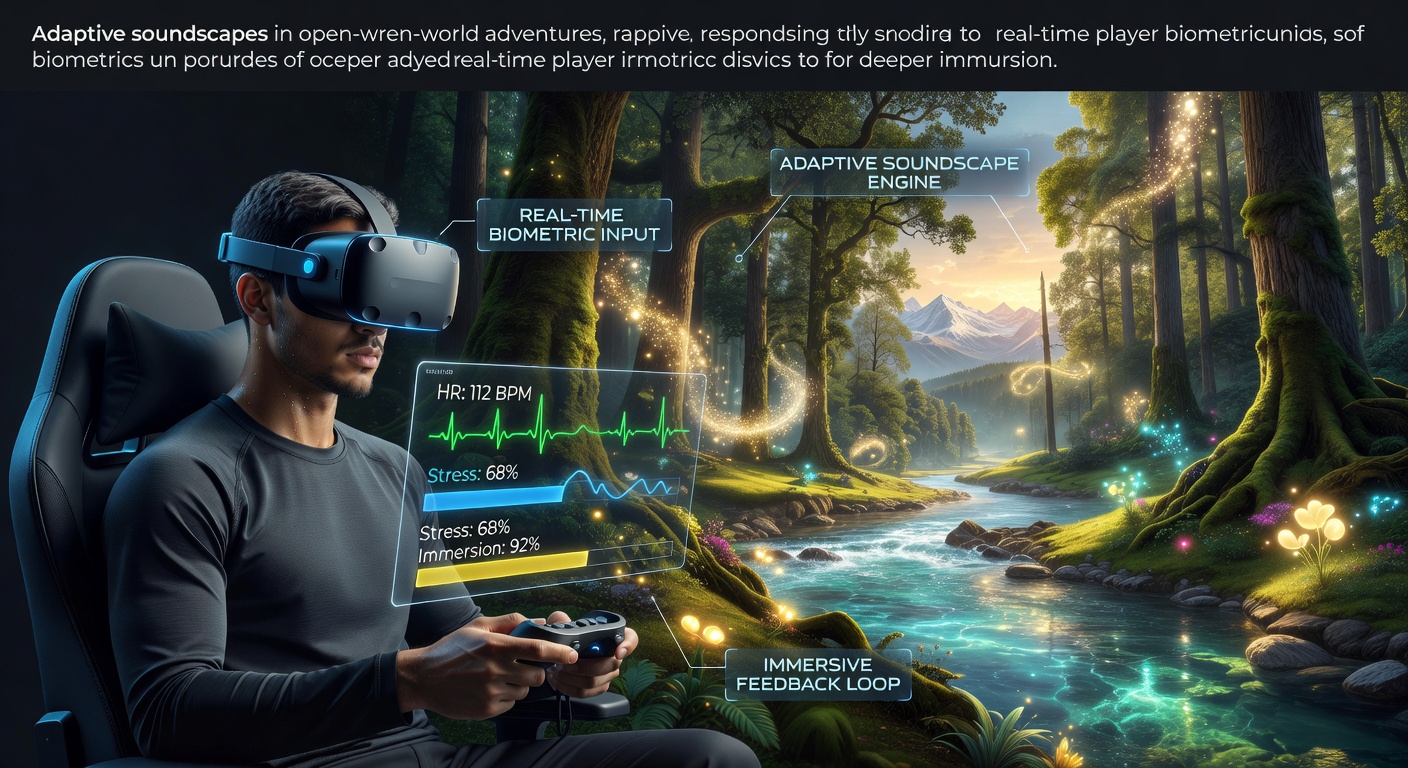
Game developers integrate biometric sensors into open-world titles so that heart rate monitors, galvanic skin response devices, and EEG headbands feed continuous data streams into audio engines, and these inputs trigger immediate adjustments to music layers, ambient effects, and spatial audio positioning. Systems process signals at sub-second intervals, allowing footsteps on virtual terrain to soften when a player's pulse drops or to layer in distant echoes when arousal metrics rise. Data from multiple sensor types combines through middleware that maps physiological ranges to parameter banks in the sound engine, creating transitions that avoid abrupt cuts.
Core Technology Behind Real-Time Audio Adaptation
Hardware such as wrist-worn optical heart rate sensors and lightweight EEG bands connect wirelessly to the game client, sending packets that the audio middleware interprets through pre-trained models calibrated on large player datasets. When a model detects elevated skin conductance, the engine raises reverb on environmental sounds and introduces low-frequency pulses under the main score, while reduced heart rate variability prompts the system to thin out competing audio tracks and emphasize subtle wind or wildlife cues. Developers calibrate thresholds during beta testing so that individual baselines rather than absolute values drive changes, which prevents one-size-fits-all responses across diverse player physiology.
Sound designers pre-author multiple concurrent stems for each region, and the adaptive layer selects or blends stems according to biometric vectors updated every 200 milliseconds. In titles released through 2025 and into June 2026, middleware from middleware vendors now includes dedicated biometric input nodes that accept encrypted streams from approved wearables, ensuring compliance with regional data protection rules while maintaining low latency on consumer hardware.
Examples Across Major Open-World Releases
One widely discussed implementation appears in an expansive wilderness simulator where researchers observed that players wearing compatible chest straps experienced soundscapes that shifted from bright orchestral motifs to subdued drones when heart rates exceeded 110 beats per minute during exploration segments. Another case study from a European studio showed an urban open-world title that muted distant traffic hum and amplified interior echoes when EEG data indicated focused attention states, a technique rolled out in a mid-2026 patch. Observers note that these adjustments occur without interrupting core gameplay loops, because the audio engine performs crossfades rather than discrete switches.
Integration With Existing Game Systems
Adaptive audio layers sit alongside procedural generation systems that already handle weather, time of day, and NPC behavior, yet biometric data adds a personal dimension that remains invisible to other players in multiplayer sessions. Studios achieve separation by routing biometric parameters through client-side processing only, so each participant hears a unique mix while shared world events stay synchronized. Technical documentation released by several development teams in early 2026 describes how biometric values map onto existing mixer buses without requiring new art assets, which keeps file sizes manageable for download.

Research Findings and Industry Data
Studies conducted at institutions across North America and the Asia-Pacific region indicate that real-time audio adaptation correlates with measurable changes in player engagement metrics collected during controlled play sessions. Figures released by the Entertainment Software Association of Canada in 2025 reveal that titles incorporating biometric audio feedback reported average session lengths 12 percent longer than matched control versions without the feature. Researchers at an Australian university lab tracked skin conductance alongside self-reported immersion scores and found stronger alignment when sound changes responded directly to biometric spikes rather than scripted events alone.
According to reports from the National Science Foundation, grant-funded projects exploring affective computing in games have accelerated middleware development that supports multiple sensor protocols simultaneously. These advances allow developers to incorporate data from emerging wearable categories without rewriting core audio pipelines each time new hardware reaches the market.
Implementation Challenges and Solutions
Latency remains a primary concern because biometric signals must reach the audio engine before noticeable delay occurs, and studios address this through predictive buffering that anticipates likely parameter shifts based on recent trends. Battery drain on player devices presents another constraint, yet optimized transmission schedules that send updates only when values cross defined thresholds reduce power consumption while preserving responsiveness. Privacy considerations lead teams to store raw biometric streams locally and transmit only derived parameter values to game servers, a practice documented in compliance guides published by several regulatory bodies in the European Union.
Calibration routines run at the start of each session so that the system establishes a personal baseline within the first few minutes of play, after which ongoing adjustments remain relative to that baseline. This approach accommodates differences in resting heart rates and skin conductivity across age groups and fitness levels without requiring manual configuration from players.
Conclusion
Adaptive soundscapes that respond to real-time player biometrics now operate in multiple open-world releases, drawing on sensor data processed through established middleware to alter music and ambient layers dynamically. Industry reports and academic studies document the technical pathways that enable these responses, while ongoing hardware improvements support broader adoption. As calibration methods and privacy protocols continue to mature, the same frameworks extend to additional titles scheduled for release after June 2026.