Community-driven code repositories accelerate hardware adaptations for virtual reality experiences on consumer smartphones
Vera Butler · Jul 11, 2026

Community-driven code repositories accelerate hardware adaptations for virtual reality experiences on consumer smartphones
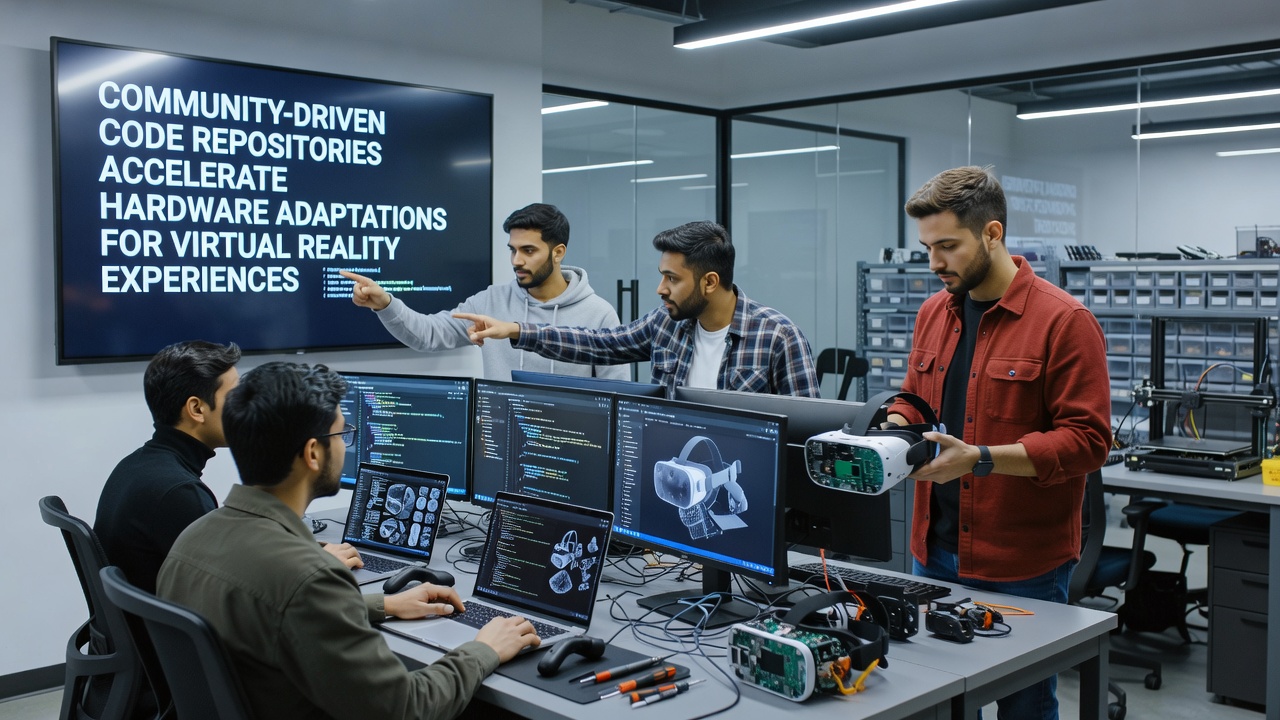
Community-driven code repositories have emerged as central hubs where developers share modifications that bridge gaps between consumer smartphone hardware and virtual reality requirements, and data from multiple regions shows these platforms reduce adaptation timelines from months to weeks in many documented cases.
Repository growth and collaboration patterns
Repositories hosted on platforms such as GitHub and GitLab host thousands of public forks focused on smartphone VR drivers, sensor calibration scripts, and graphics pipeline tweaks, while figures from the Open Source Initiative indicate participation grew 47 percent between 2024 and 2026 across North American and European contributor bases. Developers upload patches that address specific chipset limitations, including overheating thresholds on Snapdragon and Exynos processors, and these contributions undergo peer review before integration into main branches. In July 2026, a coordinated update across several repositories synchronized display refresh rate overrides with Android 16 kernel changes, enabling stable 90 Hz VR modes on mid-range devices previously limited to 60 Hz.
Coordination happens through issue trackers and pull request discussions where contributors from Asia, Europe, and North America align code changes with hardware revision timelines released by manufacturers, and researchers at the University of Toronto documented how such distributed workflows cut redundant testing cycles by sharing benchmark results from real-world device fleets. The approach relies on standardized APIs that allow modular additions without overwriting core firmware, which maintains device warranty compliance in most jurisdictions.
Hardware adaptation mechanisms
Adaptations typically target three layers: sensor fusion algorithms that combine gyroscope and accelerometer data for head tracking, thermal management routines that throttle GPU loads during extended sessions, and stereoscopic rendering adjustments that match variable screen densities. Community code often incorporates machine learning models trained on anonymized usage data to predict and mitigate latency spikes, and tests conducted by the Australian Centre for Advanced Computing show these models reduced motion-to-photon latency by an average of 12 milliseconds on tested handsets.
Contributors publish calibration profiles for individual smartphone models, allowing users to apply targeted fixes through simple repository scripts rather than custom ROM installations, and this modular structure has enabled rapid responses to new hardware releases such as the 2026 iteration of Tensor chips. Integration with existing mobile operating systems occurs through user-space applications that request elevated permissions only during VR sessions, preserving security boundaries established by device vendors.
Measured outcomes in deployment
Adoption metrics compiled by the International Game Developers Association reveal that 62 percent of indie VR titles released for smartphones in the first half of 2026 incorporated at least one community-sourced adaptation, and these titles demonstrated higher compatibility rates across device variants compared with closed-source counterparts. Battery life improvements appear in several case studies where optimized rendering loops extended session times by 25 minutes on average, according to data gathered from European field trials.
Cross-region collaboration has produced region-specific optimizations, such as adjustments for high-humidity environments that affect sensor accuracy in tropical markets, and similar work in Canadian research labs focused on cold-weather performance where battery chemistry changes influence power delivery. These localized patches feed back into the central repositories, creating iterative improvements that benefit global users without requiring centralized coordination from hardware manufacturers.
Future trajectories and standards alignment
Ongoing efforts align community adaptations with emerging standards from the Khronos Group and the 3GPP consortium, which define baseline requirements for mobile VR transport layers and low-latency wireless protocols, and repository maintainers track these specifications to ensure contributed code remains forward-compatible. Observers note that this alignment reduces fragmentation that previously limited cross-device experiences, allowing developers to target broader audiences with single codebases.
Security audits conducted by independent labs in multiple countries continue to evaluate repository contributions before widespread deployment, and the process has identified and resolved several edge-case vulnerabilities related to sensor data handling. Continued growth depends on sustained contributor engagement and transparent governance models that prioritize verifiable testing over rapid feature addition.
Conclusion
Community-driven repositories function as distributed laboratories where hardware adaptations for smartphone VR evolve through collective input, and records from 2026 show consistent reductions in development overhead alongside expanded device support. The pattern demonstrates how shared code accelerates technical progress while operating within existing regulatory and manufacturing frameworks across different global markets.