Sensor Arrays Enable Gesture Synchronization in Hybrid AR Setups for Remote Collaborative Asset Creation
Leon Vogel · Aug 8, 2026
Sensor Arrays Enable Gesture Synchronization in Hybrid AR Setups for Remote Collaborative Asset Creation
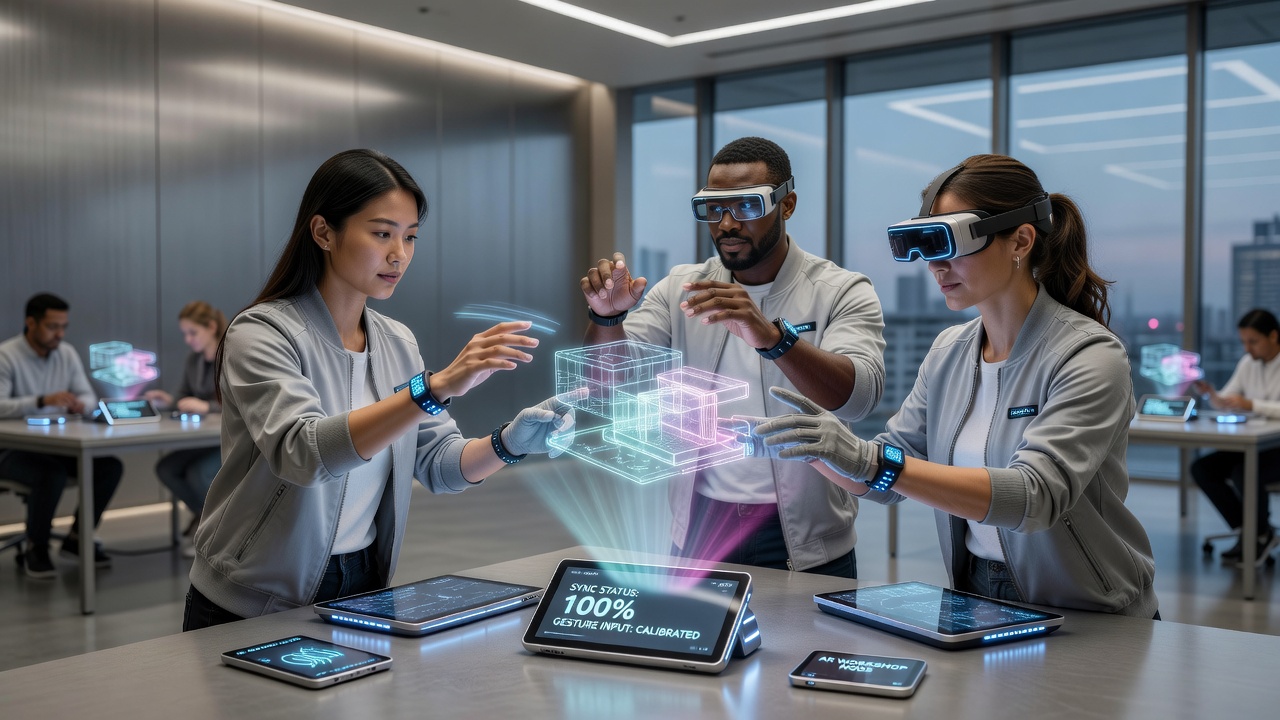
Developers and researchers have integrated sensor arrays into hybrid device configurations that combine smartphones, tablets, head-mounted displays, and dedicated controllers to capture and align user gestures during remote augmented reality sessions focused on building shared digital assets, and these systems rely on multi-modal data streams that fuse inertial measurements with computer vision outputs to maintain consistency across participants located in different physical spaces.
Studies from institutions like the National Institute of Standards and Technology have documented protocols that timestamp gesture data at the point of capture so that arrays on separate devices can reconcile movements even when network jitter occurs, while fusion algorithms compensate for differences in sensor sampling rates and device orientations to produce unified representations of hand positions and object manipulations.
Hybrid Device Configurations and Data Alignment
Engineers design these setups so that a user wearing an AR headset can extend a hand toward a virtual model while another participant on a tablet adjusts the same asset from a different angle, and the arrays detect joint angles, finger curls, and wrist rotations before transmitting normalized vectors that all connected clients interpret identically. Calibration routines run at session start to establish common coordinate frames, and ongoing corrections adjust for drift that accumulates from gyroscope bias or camera tracking loss.
Researchers at the Commonwealth Scientific and Industrial Research Organisation in Australia have examined how arrays mounted on multiple form factors maintain synchronization when one participant switches from a handheld controller to freehand interaction, and their findings indicate that hybrid fusion layers reduce misalignment errors to sub-centimeter levels in controlled tests conducted through mid-2026.
Gesture Capture in Remote Workshops
Workshops conducted over distributed networks allow teams to manipulate 3D models of game environments or product prototypes in shared AR spaces, and each gesture performed on one device triggers corresponding visual updates on all others because sensor arrays feed into a common event bus that prioritizes low-latency transmission of positional deltas. Participants often begin sessions by aligning reference points on a shared virtual table, after which the system tracks subsequent movements relative to that origin.
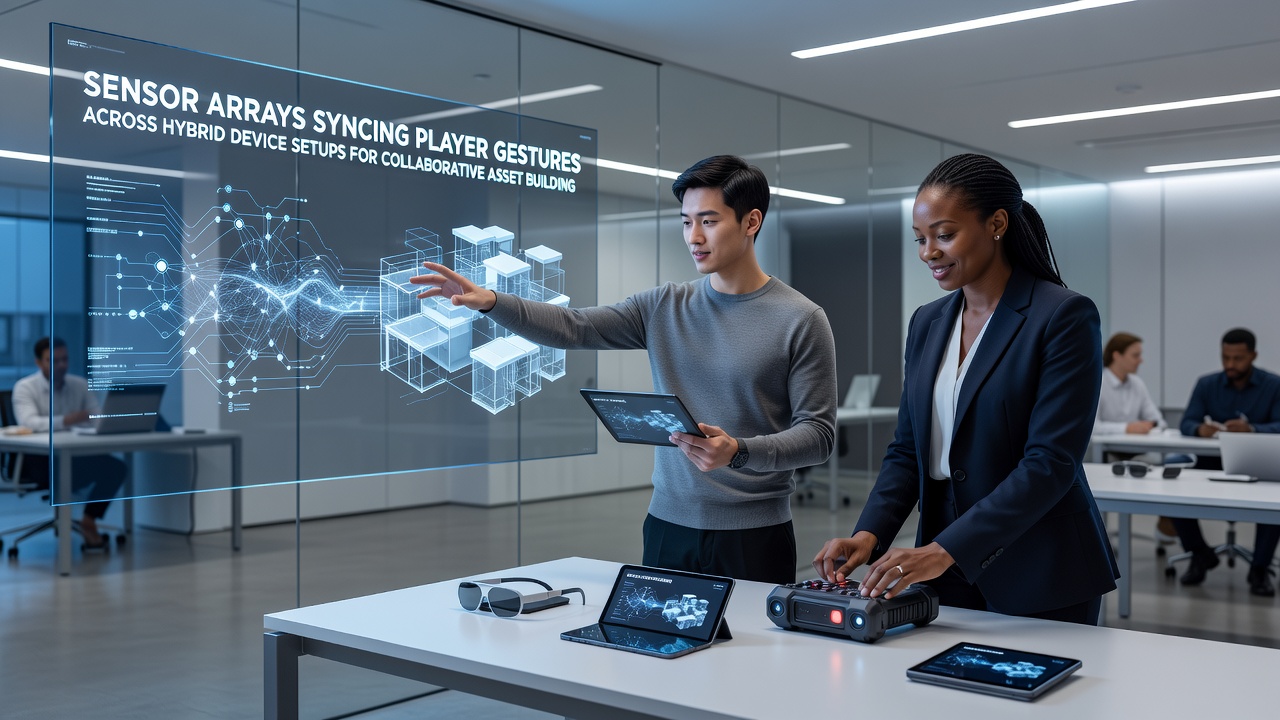
During an August 2026 demonstration organized by an industry consortium, teams assembled modular level geometry by gesturing to place, rotate, and scale components, and the arrays ensured that a pinch motion performed on a smartphone corresponded exactly to the same scaling action observed through a headset worn by a colleague thousands of kilometers away. Redundancy mechanisms discard duplicate packets while preserving the most recent valid gesture frame to prevent jitter in the shared view.
Technical Protocols Supporting Collaboration
Communication stacks employ standardized message formats that encapsulate sensor readings alongside device metadata, allowing receivers to apply transformation matrices that account for each user's viewpoint and scale. When one participant rotates an asset with both hands, the arrays capture opposing forces and transmit them as coupled events so that remote users see coherent motion rather than independent fragments. Edge processing nodes located near workshop servers handle initial filtering to reduce bandwidth demands on long-haul connections.
Observers note that these pipelines support variable participation numbers because new devices can join mid-session and inherit the current calibration state without requiring a full restart. Data logs from such sessions reveal that average synchronization intervals fall below 20 milliseconds when arrays operate under typical home and office network conditions.
Asset Building Workflows and Integration Points
Asset pipelines ingest the synchronized gesture streams directly into modeling applications that render changes in real time, and version control layers record each manipulation as a discrete commit tagged with the originating device and timestamp. Teams iterate on geometry, materials, and animations by gesturing through successive refinements, and the arrays maintain consistency even when participants toggle between coarse positioning and fine detail work.
Integration with existing engines occurs through plugin interfaces that map array outputs to native transform nodes, so developers avoid custom middleware while still gaining cross-device parity. Reports from academic groups indicate that workshops using these arrays complete iterative cycles faster than those relying on mouse-and-keyboard input alone because direct gesture mapping reduces the cognitive load of translating intent into interface actions.
Conclusion
Sensor array deployments continue to expand the practical reach of remote augmented reality workshops by delivering reliable gesture synchronization across mixed hardware, and ongoing refinements in fusion techniques and protocol design support increasingly complex collaborative asset construction tasks. Data from multiple research programs show measurable improvements in alignment accuracy and session stability, which in turn enable broader adoption among distributed creative teams working on games, simulations, and product prototypes.