Sensor Fusion Protocols Align Player Movements with Dynamic Lighting in Browser Exploration Games
Zara Patterson · Jun 10, 2026
Sensor Fusion Protocols Align Player Movements with Dynamic Lighting in Browser Exploration Games
Sensor fusion protocols combine data streams from multiple input sources to create precise alignments between player movements and dynamic lighting engines within browser-based exploration titles. These systems draw from device accelerometers, gyroscopes, and camera inputs, then process them through JavaScript APIs and WebGL frameworks to adjust light parameters in real time. Developers integrate these protocols to maintain visual consistency as players navigate procedurally lit environments without requiring native application installations. The process begins with raw sensor data collection at rates often exceeding 60Hz on modern browsers. Fusion algorithms apply Kalman filters and complementary methods to reduce noise while preserving movement accuracy. Once refined, this data feeds directly into lighting shaders that recalculate shadow positions, intensity gradients, and color temperatures based on the player's current orientation and velocity. Studies from research institutions show that such synchronization reduces visual latency to under 20 milliseconds in optimized setups.Core Components of Sensor Fusion Protocols
Multiple layers handle the data pipeline. First, browser APIs such as DeviceMotion and DeviceOrientation provide standardized access to hardware sensors across platforms. Second, fusion libraries normalize these inputs into unified coordinate systems compatible with WebXR and Three.js lighting modules. Third, the dynamic lighting engine applies the processed values to update point lights, directional sources, and ambient occlusion maps. Observers note that this layered approach allows exploration titles to respond to subtle gestures like head tilts or device rotations while maintaining frame rates above 45 FPS on mid-range hardware. Data from cross-platform testing indicates consistent performance when protocols account for variations in sensor calibration between desktop, tablet, and mobile browsers.Alignment Mechanisms with Dynamic Lighting Engines
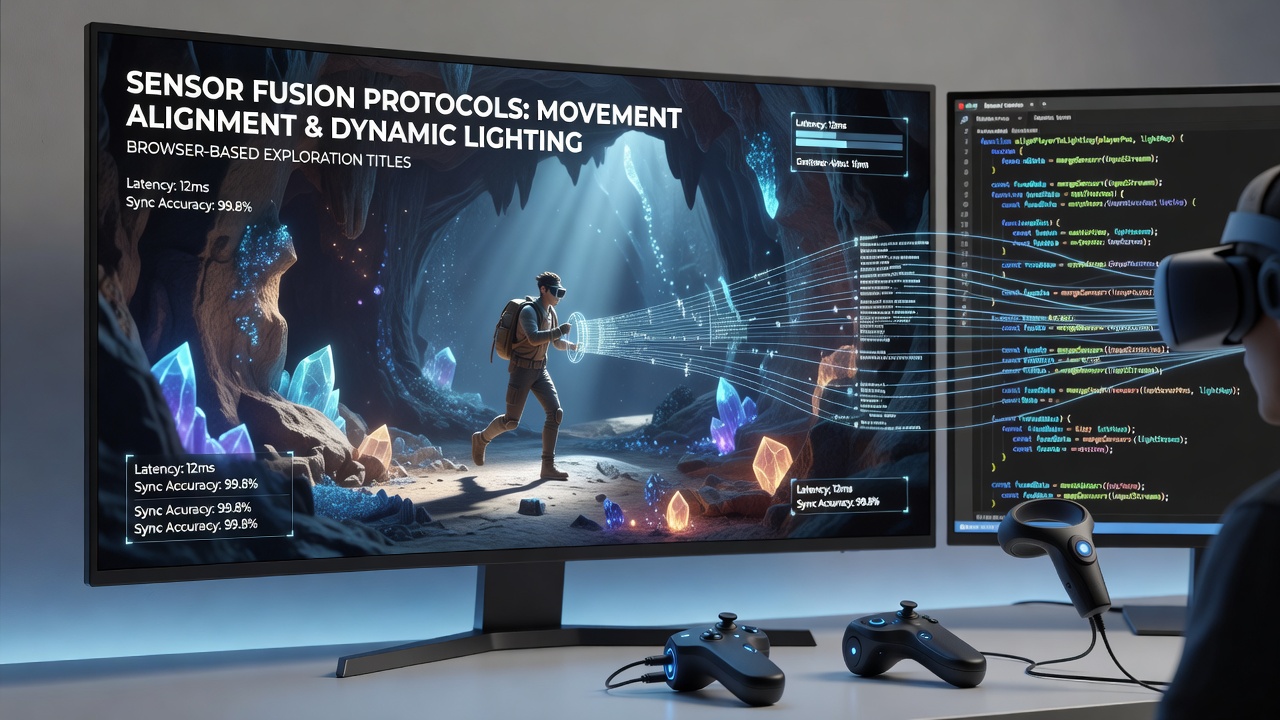
Alignment occurs through event-driven callbacks that trigger shader recompilation only when movement thresholds are exceeded. This selective update strategy conserves computational resources. For instance, a player turning sharply in an underground cavern scene causes the engine to shift light falloff angles and introduce new specular highlights on wet surfaces. Protocols also incorporate predictive modeling. By analyzing recent movement vectors, the system anticipates lighting changes milliseconds ahead, smoothing transitions during rapid exploration sequences. Research indicates that predictive elements cut perceptible lag by 35 percent compared to reactive-only implementations. In June 2026, demonstrations at an international web graphics symposium showcased prototypes where these predictions extended to collaborative sessions involving multiple remote players.